ZK‑Rollups are transforming blockchain scalability by offering a cost‑efficient and secure way to handle transactions off‑chain while maintaining on‑chain data integrity. As one of the most advanced Layer 2 solutions, ZK‑Rollups use Zero‑Knowledge Proofs (ZKPs) to validate large batches of transactions in a single on‑chain proof. This approach significantly reduces gas fees, improves transaction throughput, and opens up new possibilities for Web3 developers and enterprises seeking scalable infrastructure.
While many Layer 2s promise scalability, Orochi takes it further, optimising ZK‑Rollups specifically for data proof scalability. With its proprietary zkDatabase and advanced proof generation system, Orochi enables developers to achieve both cost efficiency and cryptographic verifiability across decentralized applications.
What Are ZK‑Rollups and How Do They Improve Blockchain Scalability?
ZK‑Rollups are Layer 2 solutions that dramatically improve blockchain scalability by moving computation and storage off the main chain while preserving security and data integrity. Instead of posting every transaction on-chain, they aggregate hundreds or thousands of transactions into a single validity proof that the Layer 1 blockchain can verify. This mechanism reduces congestion, lowers gas fees, and enables high-throughput applications such as DeFi, NFTs, and Web3 gaming.
In 2024–2025, projects like zkSync, StarkNet, and Polygon zkEVM processed millions of transactions at a fraction of the cost of Ethereum Layer 1. For example, zkSync reportedly handled over 5 million transactions per month with average fees under $0.01 per transaction, showcasing how ZK‑Rollups enable cost‑effective mass adoption.
By leveraging Zero-Knowledge Proofs (ZKPs), ZK-Rollups ensure that every batched transaction is mathematically verified, guaranteeing that users cannot cheat the system, all without revealing sensitive data. This feature makes them ideal for enterprise-grade applications, where privacy, auditability, and compliance are critical.
How Do ZK‑Rollups Bundle Transactions Off‑Chain?
To understand how ZK‑Rollups work, consider them as systems that bundle hundreds (or thousands) of off‑chain transactions into a single proof. This batch is then submitted to the base layer (Layer 1) as one validation event. The transaction data stays off‑chain (or is heavily compressed), which minimises on‑chain data storage and reduces network congestion.
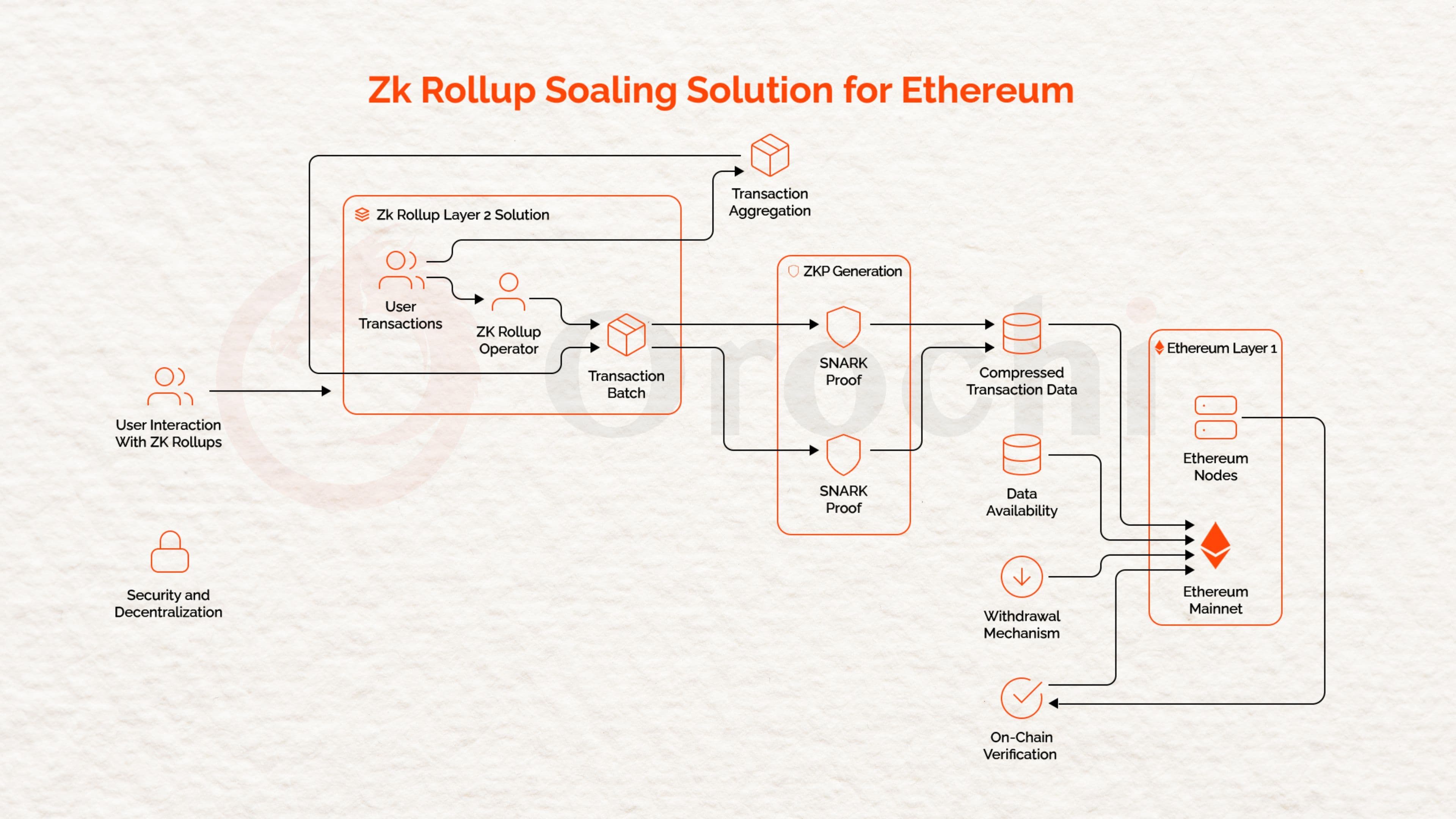 Unlike Plasma and Validiums, rollups (both ZK and optimistic) don’t fully implement layer 2 scaling. A rollup compresses transaction data. On Ethereum, a signature takes 68 bytes. By contrast, a rollup can batch ~100 transactions under a single signature, reducing the size to 0.5 bytes.
By leveraging this approach, ZK‑Rollups enhance blockchain scalability while delivering a major drop in gas costs for users.
What Are the Key Components of ZK‑Rollups?
ZK‑Rollups rely on three critical components: sequencers, smart contracts, and validity proofs.
- Sequencers: These gather and order off‑chain transactions (the “batching system”).
- Smart Contracts: On the base layer they store the state root of the rollup and verify proofs.
- Validity Proofs: Generated off‑chain (or in parallel) using technologies like zk‑SNARKs or zk‑STARKs, these cryptographically confirm that the off‑chain state transitions are valid.
- zk‑SNARKs are compact and efficient;
- zk‑STARKs offer transparency (no trusted setup) and more resistance to quantum attacks.
How Do ZK‑Rollups Ensure Security While Offloading Computation?
Although computation happens off‑chain, ZK‑Rollups inherit Layer 1 security because the final proof is verified on‑chain and the contract enforces correct state roots. As one explanation puts it:
ZK‑Rollups execute most computation off‑chain but preserve Layer 1 security. They do this by posting a succinct validity proof to the base chain, where a smart contract verifies the proof and enforces the canonical state root. If the proof is valid, the on‑chain contract updates the rollup’s state; if not, it rejects it—preventing any incorrect transitions.
This design ensures users maintain a trust‑minimized escape hatch: assets can always be withdrawn back to Layer 1 based on the last verified state. In other words, even if off‑chain components fail or behave maliciously, the chain‑verified proofs and state commitments protect user funds.
Zero‑Knowledge Proofs provide these guarantees without exposing sensitive data. They prove correctness of batched off‑chain work, privately and efficiently, so systems can scale while retaining strong decentralised security anchored to the base layer.
What Are the Advantages of ZK‑Rollups Over Optimistic Rollups?
ZK‑Rollups offer several advantages over Optimistic Rollups, particularly in speed, cost, privacy, and security guarantees. While both solutions aim to scale Layer 1 blockchains, ZK‑Rollups leverage cryptographic proofs for immediate verification, whereas Optimistic Rollups rely on fraud proofs that introduce delays and additional risk.
Why Is Instant Finality a Game‑Changer?
One of the most significant advantages of ZK‑Rollups compared to Optimistic Rollups is instant finality. In Optimistic Rollup systems, users must wait through a challenge period, typically up to 7 days, before withdrawing funds to Layer 1. This delay exists to allow other participants to submit fraud proofs if an invalid transaction occurs.
ZK‑Rollups, however, submit a cryptographic validity proof that mathematically guarantees the correctness of all batched transactions. Once the proof is verified on-chain, all state transitions and withdrawals are final—no waiting period is required.
For example:
- zkSync Era enables DeFi users to deposit and withdraw assets almost instantly, supporting high-speed trading and payment applications without the multi-day waiting periods required by Optimistic Rollups.

- StarkNet leverages zk-STARK proofs to finalize transactions within seconds, allowing NFT marketplaces and gaming platforms to maintain fast user experiences even under heavy load.
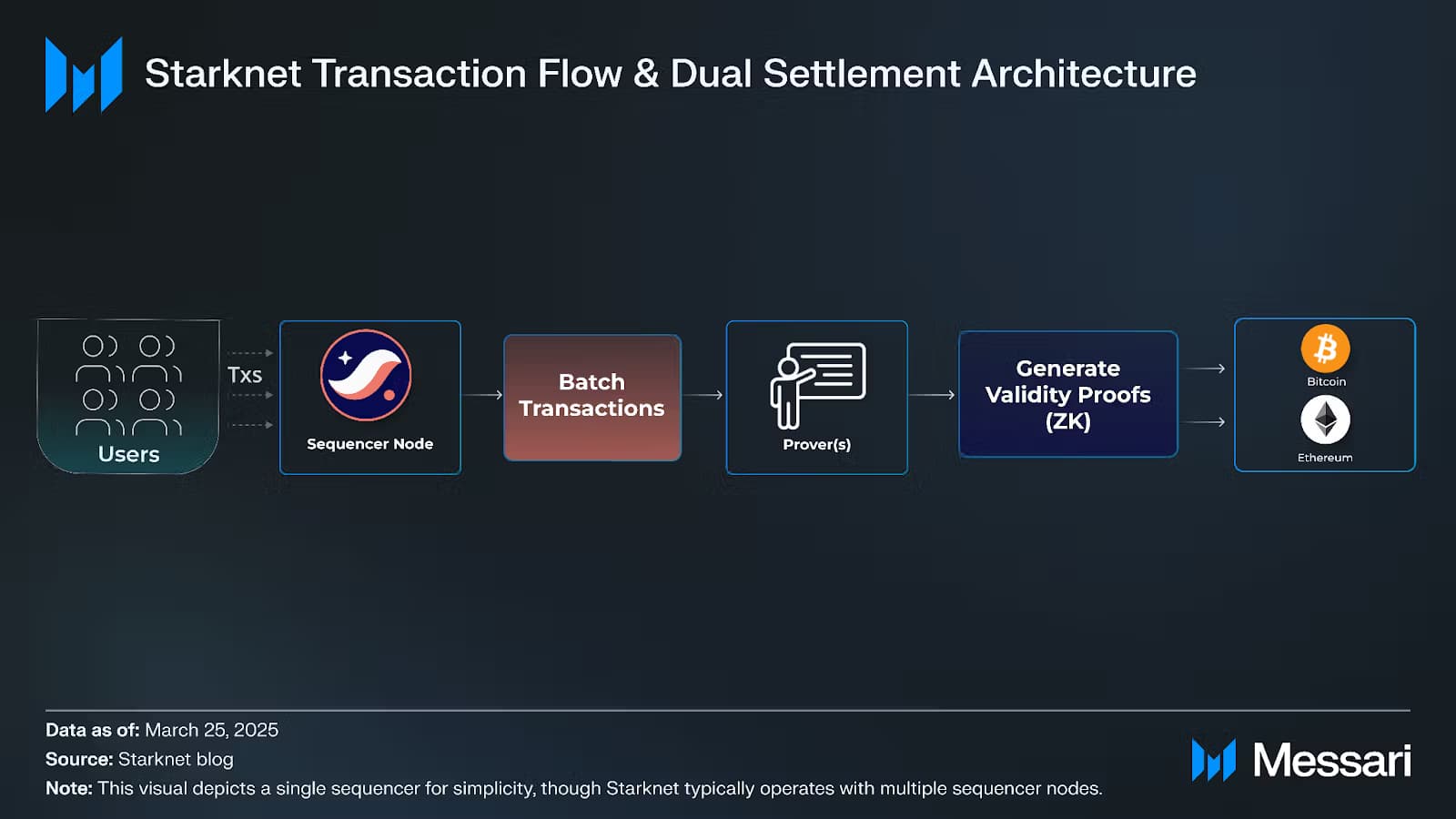
The implications of instant finality are profound for industries where speed and liquidity are critical:
- DeFi: Traders can move assets quickly between Layer 2 and Layer 1, enabling more responsive arbitrage, lending, and liquidity operations.
- Gaming & Metaverse: Players experience immediate confirmation of in-game purchases, rewards, and asset transfers, avoiding long wait times that would hurt adoption.
- Micropayments: Applications like streaming services or pay-per-use models benefit from near-zero latency in transaction settlement.
How Do ZK‑Rollups Enhance Privacy Compared to Optimistic Rollups?
ZK‑Rollups can enable privacy‑preserving systems because zero‑knowledge proofs validate correctness without revealing inputs. Instead of publishing full transaction details, the rollup commits to a state update and proves that all constraints were met. This opens a path to confidential transfers, selective disclosure for compliance, and auditability without exposing sensitive data.
Example:
- A payroll dApp pays employees in stablecoins. With a ZK‑Rollup, the contract verifies that each payment is authorized and within budget using a proof, but individual salaries remain private to external observers. Auditors can still verify totals and policy compliance via view keys or proof‑based attestations.
How ZK‑Rollups Reduce Costs for Developers and Users
ZK‑Rollups lower on‑chain costs by batching many transactions, compressing data (posting only minimal commitments), and moving heavy computation off‑chain to provers. Users pay for a small share of a batch rather than full transaction execution on L1, while developers benefit from cheaper contract interactions and higher throughput.
Example:
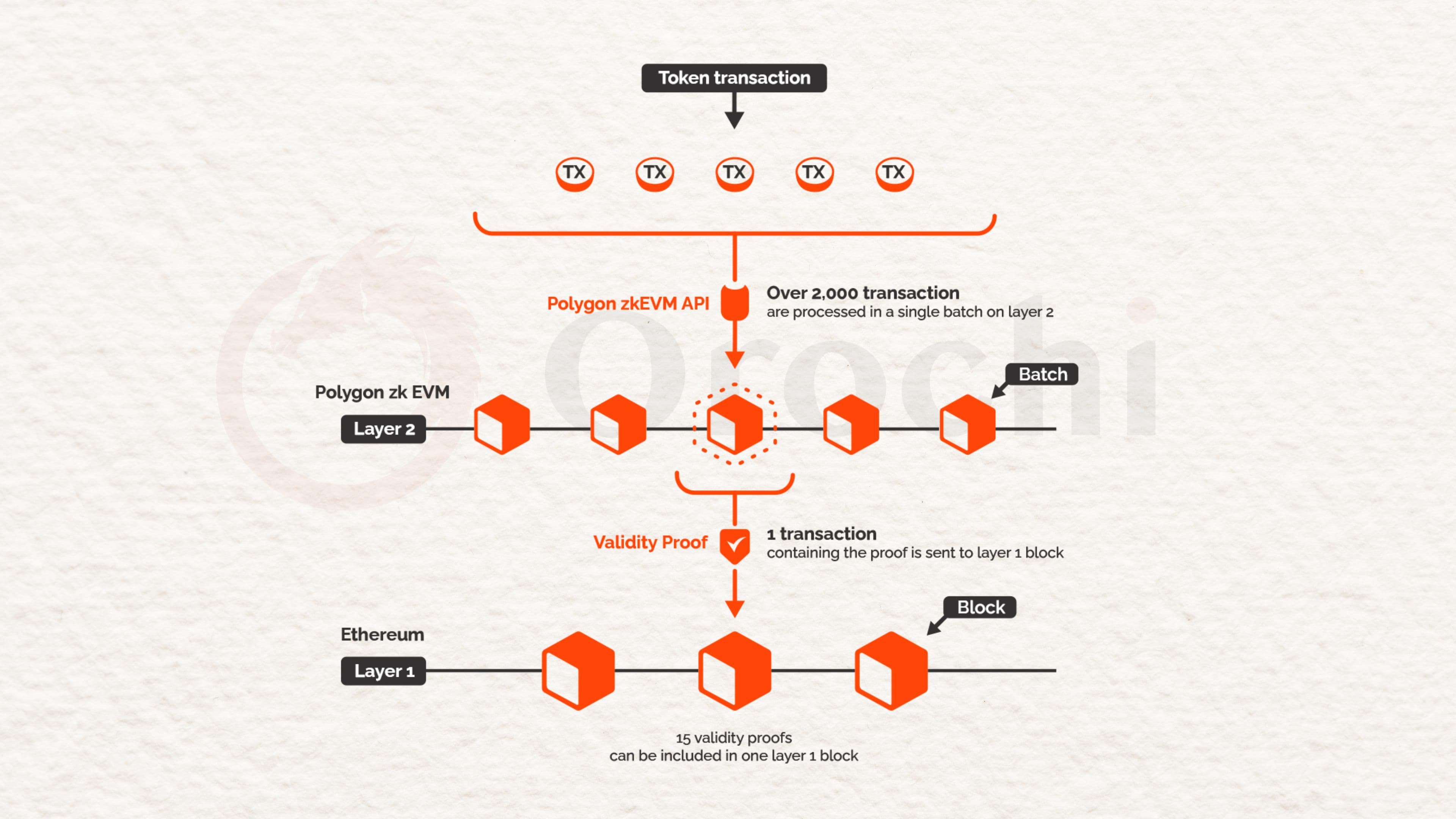
- A consumer wallet batches 2,000 transfers into one rollup block. On‑chain, it posts a compact validity proof and a few kilobytes of data. Each user’s effective gas drops dramatically compared to submitting 2,000 separate L1 transactions, and confirmations arrive faster because verification of a single proof is quick.
How Does zkEVM Enable Ethereum Compatibility?
zkEVM makes ZK‑Rollups feel like “just another EVM chain” to developers and users. It reproduces the Ethereum execution environment—opcodes, gas metering, call semantics, and state model—inside a zero‑knowledge proving system. As a result, contracts compile from Solidity/Vyper to bytecode that executes under zkEVM, while a validity proof of the block’s execution is verified on Ethereum L1.
What Is zkEVM and Why Is It Important?
The zkEVM (Zero‑Knowledge Ethereum Virtual Machine) bridges familiar EVM tooling with ZK scalability. It re‑implements the EVM in a form amenable to proof systems (zk‑SNARKs/zk‑STARKs), so ordinary smart contracts can run on Layer 2 and each block’s execution is proven correct to L1. This delivers:
- Ethereum‑level security via on‑chain proof verification
- Lower fees and higher throughput from off‑chain execution + batched proofs
- Minimal friction for teams already building with EVM languages, tools, and libraries
How zkEVM Enables Compatibility (Under the Hood)
- Opcode Equivalence: zkEVM maps Ethereum opcodes (ADD, SSTORE, CALL, etc.) to constraint systems that can be proven in ZK, preserving expected behavior and gas accounting.
- State Model Parity: Accounts, balances, storage, logs, and events follow Ethereum’s state rules; the rollup posts the new state root + validity proof to L1.
- Transaction Semantics: Nonces, signatures, gas, reverts, and event emission work like on Ethereum, enabling unchanged wallet and indexer UX.
- Tooling Continuity: Compilers (Solc/Vyper), frameworks (Hardhat/Foundry), debuggers, and wallets (MetaMask) interact with zkEVM networks using standard RPC methods.
- Proof Pipeline: Sequencer executes transactions, prover generates a succinct proof of the block’s execution, and the L1 verifier contract checks the proof before updating the canonical state root.

How Does zkEVM Simplify Developer Adoption of Layer 2?
zkEVM retains the EVM developer experience, so teams can migrate with little or no rewriting:
- Drop‑in Deployment: Use your existing Solidity/Vyper contracts and deploy to zkEVM with familiar CLI commands.
- Same Toolchain: Keep Hardhat/Foundry tests, scripts, and CI; swap network configs and RPC endpoints.
- Wallet & Infra Reuse: MetaMask, Ledger, Ethers.js, Web3.js, The Graph, and popular indexers work out of the box or with minor config changes.
- Faster Iteration: Lower transaction costs enable more testing on live networks; proofs give deterministic finality once verified on L1.
Examples
- DeFi Protocol Migration: A Uniswap‑style AMM deploys the same Solidity contracts to zkEVM. Liquidity provisioning, swaps, and fee accounting work unchanged. Users sign with MetaMask; the sequencer batches swaps; the prover submits a validity proof to Ethereum. Result: cheaper swaps, near‑instant confirmations, and L1‑anchored security.
- Enterprise Permissions & Audits: A compliance‑aware treasury runs role‑based controls in Solidity. zkEVM executes transfers and policy checks, then proves correctness to L1 without exposing internal decision data. Auditors read on‑chain events and, when needed, verify selective‑disclosure proofs, keeping sensitive logic private while preserving verifiability.
- Game / NFT Minting at Scale: A game studio’s minting and marketplace contracts compile as usual. zkEVM batches thousands of mints per block, with one proof verified on Ethereum. Creators pay a fraction of L1 gas, while users retain the familiar wallet/signing flow and final settlement on L1.
Why Are ZK‑Rollups Critical for the Future of Web3 and Layer 2 Adoption?
ZK‑Rollups are widely regarded as one of the most promising solutions for scalable, secure, and cost-efficient blockchain adoption. They not only address Ethereum’s congestion and high fees but also enable a new generation of applications that require both speed and trustless verification.
How Do ZK‑Rollups Enable Mass Adoption of Blockchain?
As blockchain adoption grows globally, scalability and affordability are essential to serve millions of users. ZK‑Rollups allow developers to process thousands of transactions per second while keeping costs low. For instance, Loopring, a zk-Rollup DEX, enables users to trade without paying high gas fees, driving greater adoption among retail traders.
By dramatically lowering the barrier to entry, ZK‑Rollups make mass adoption of blockchain technology feasible for everyday applications, from micropayments to large-scale DeFi systems.
How Do ZK‑Rollups Support Privacy and Compliance Simultaneously?
ZK‑Rollups demonstrate that privacy-preserving and compliant systems can coexist. Zero-Knowledge Proofs enable verification of compliance rules, such as KYC checks, transaction limits, or audit requirements, without exposing sensitive data. For example:
- Polygon zkEVM and enterprise zkRollup solutions allow financial institutions to verify Proof-of-Reserves or KYC compliance while maintaining client privacy.
- Healthcare or supply-chain platforms can ensure that data integrity and regulatory standards are met without revealing confidential information, paving the way for enterprise adoption of Web3.
This dual capability, privacy + compliance, positions ZK-Rollups as the backbone of enterprise-grade Web3 infrastructure.
How Do ZK‑Rollups Foster a Developer‑Friendly Ecosystem?
ZK‑Rollups support customizable Layer 2 networks, allowing developers to tune parameters like transaction speed, privacy level, and gas cost to suit their application. With frameworks like Orochi, teams can:
- Build DeFi protocols with fast, low-cost transactions and verifiable Proof-of-Reserves.
- Launch NFT marketplaces with real-time transfers and low fees.
- Integrate AI-driven dApps where data privacy and verification are essential.
- Deploy enterprise solutions with audit-grade data integrity across multiple chains.
Real-world adoption:
- zkSync’s developer-friendly SDKs allow teams to migrate Ethereum smart contracts with minimal changes.
- StarkNet and Polygon zkEVM provide tooling for seamless integration of Solidity contracts into ZK-Rollup environments, lowering the learning curve and accelerating development.
By combining scalability, privacy, and interoperability, ZK‑Rollups create a vibrant, developer-first ecosystem that is essential for driving Layer 2 adoption and mainstream Web3 use cases.
Orochi Network is building the next generation of verifiable data infrastructure with its flagship zkDatabase, a scalable solution designed to support high-throughput, privacy-preserving applications. At the core of zkDatabase are two synergistic components: the Verifiable Data Pipeline, which ensures data integrity, auditability, and cross-chain consistency, and ZK-data-Rollups, responsible for off-chain computation, batching, and cryptographic proof generation. Together, these components enable developers and enterprises to achieve low-cost, high-speed, and fully verifiable transactions, making zkDatabase a cornerstone for DeFi protocols, NFT platforms, AI-integrated dApps, and enterprise-grade blockchain systems.
Conclusion
ZK‑Rollups represent one of the most powerful solutions for achieving blockchain scalability without sacrificing security or decentralisation. Through innovations like zkDatabase, ZK‑data‑Rollups, and the Verifiable Data Pipeline, Orochi Network redefines what’s possible in low‑cost, verifiable computation.
By optimising data proof scalability, Orochi enables developers to build efficient, privacy‑preserving systems that scale globally across Layer 2 networks. Whether in DeFi on ZK‑Rollups, enterprise data verification, or cross‑chain interoperability, Orochi’s ecosystem stands at the forefront of scalable Web3 infrastructure.
For developers exploring ZK‑Rollups, Zero‑Knowledge Proofs, and verifiable data solutions — Orochi provides the foundation for building the next generation of trustless, efficient, and compliant decentralised applications.
FAQs
Question 1: What makes ZK‑Rollups different from Optimistic Rollups?
ZK‑Rollups use cryptographic validity proofs (zk‑SNARKs/zk‑STARKs) to verify batched transactions instantly on Layer 1, so withdrawals and state updates finalize without a multi‑day challenge period. This delivers faster settlement, lower costs, and optional privacy compared to Optimistic Rollups, which rely on fraud‑proof windows.
Question 2: How does Orochi’s zkDatabase improve data proof scalability?
A2: zkDatabase combines a Verifiable Data Pipeline (for integrity, auditability, and cross‑chain consistency) with ZK‑data‑Rollups (for off‑chain computation and proof generation). Together, they enable high‑throughput, low‑cost, and fully verifiable transactions for DeFi, NFTs, AI‑driven dApps, and enterprise systems.
Question 3: Can developers migrate existing Solidity contracts to ZK‑Rollups easily?
Yes. With zkEVM compatibility, teams can deploy existing Solidity/Vyper contracts using familiar tools (Hardhat, Foundry, MetaMask). Platforms like zkSync, StarkNet, and Polygon zkEVM provide SDKs and tooling to minimize changes, cut fees, and retain Ethereum‑level security via on‑chain proof verification.


Experience verifiable data in action - Join the zkDatabase live demo!
Book a Demo