Verifiable Compliance Framework for RWA: Compliance for RWA with Verifiable Proofs
January 15, 2026
12 mins read
Compliance for RWA needs proof, not paperwork. Learn a verifiable compliance framework with audit replay, privacy, and zkDatabase by Orochi Network.

Compliance for RWA is easy to promise and hard to prove.
A tokenized RWA can look institutional on day one: legal opinions, a custodian, and neat disclosures. Then the real questions hit. Who is eligible to hold it across jurisdictions? What happens when a holder’s risk status changes? Can you prove reserves and transfer compliance at the moment an event happened, without putting sensitive records on public display?
That is why verifiable compliance must be engineered as a workflow, not compiled as paperwork. A verifiable compliance framework ties policy rules to versioned data, generates replayable evidence, and enforces checks at execution time. This is also where Orochi Network and zkDatabase fit: a proof-ready data layer that turns off-chain compliance evidence into verifiable outputs suitable for audits and on-chain enforcement.
What does Compliance for RWA actually mean in tokenization workflows?
Compliance for RWA is a workflow across issuance, distribution, transfers, reporting, and redemption. “Compliant” usually means you can demonstrate, at any point in time:
- Eligible holders own the asset
- The asset is backed and administered as promised
- Required disclosures and controls are enforced
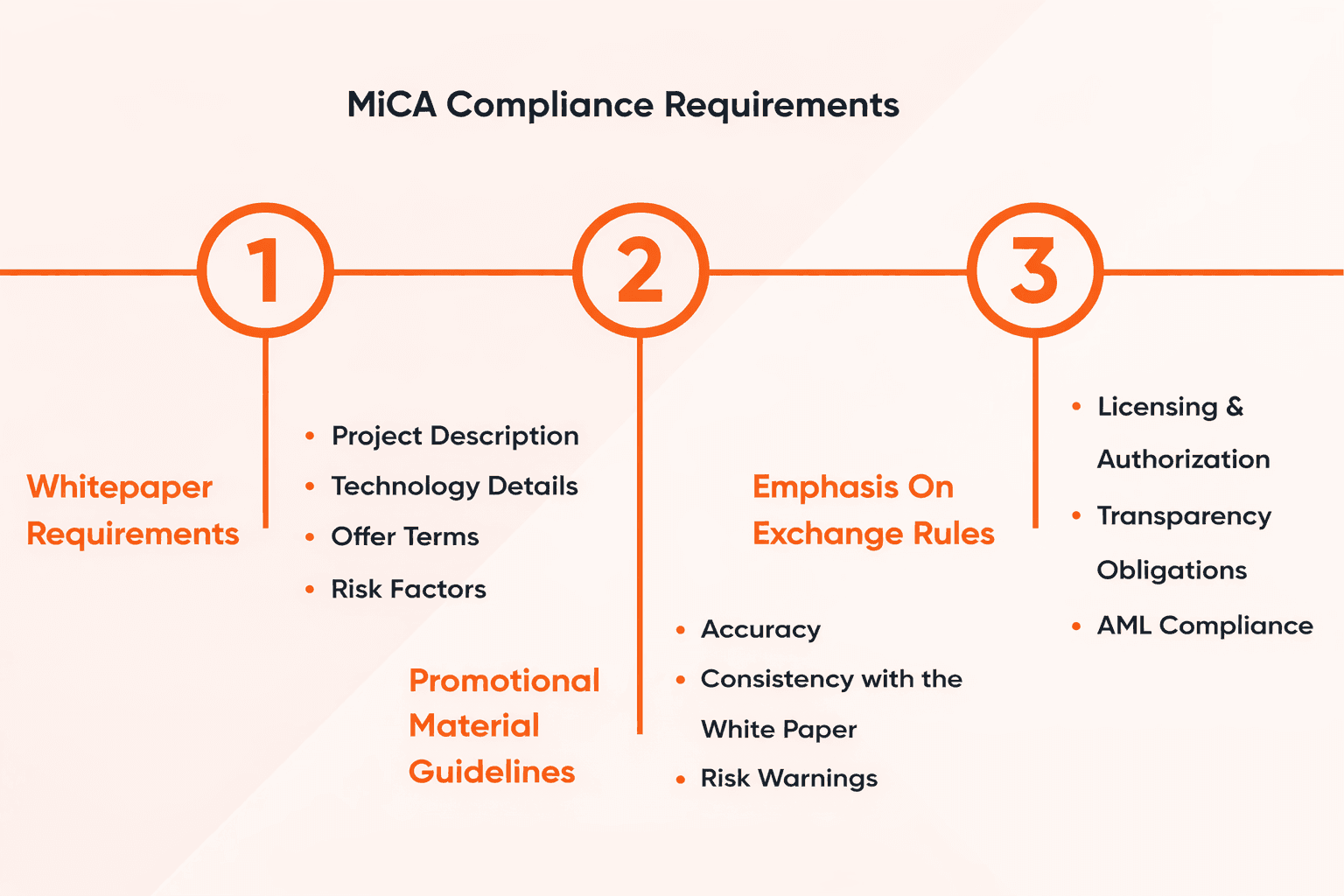
Jurisdictions differ, but the shape repeats. In the EU, MiCA sets a region-wide framework and supervision for crypto-assets and service providers, pushing clearer disclosure and authorization expectations. In Singapore, Project Guardian published industry frameworks on operationalising tokenised assets, essentially compliance translated into operating models.
Globally, AML expectations also anchor RWA distribution. FATF’s 2025 updates and best-practice notes reinforce that virtual-asset service providers should apply AML/CFT standards, including Travel Rule style information requirements where implemented.
Key parties accountable in an RWA compliance framework
Design your RWA compliance program by “who owns which evidence”:
- Issuer: product claims, disclosures, eligibility rules
- Custodian or administrator: backing statements, reconciliations, operational controls
- Identity and AML providers: KYC/AML outcomes and screening signals
- Tokenization layer: rule enforcement in smart contracts
- Auditors and regulators: independent verification and sampling
Common compliance obligations across most RWA
Most Compliance for RWA projects converge on four buckets: identity and eligibility, transfer controls, backing and NAV evidence, and a replayable audit trail. The industry is also pushing compliance closer to the token. ERC-3643 is built for permissioned tokenization, embedding identity checks and transfer restrictions into token transfers.

Why do traditional compliance approaches break for RWAs at scale?
Traditional compliance expects latency: end-of-day reconciliations, periodic attestations, quarterly audits. Tokenization compresses time. Tokens can move quickly, so compliance evidence needs to keep up.
Regulators are explicitly flagging tokenization-specific risks. IOSCO has highlighted investor uncertainty over what is actually held (the underlying asset vs a representation), plus technology and third-party issuer risks that can compound in tokenised markets.
The first failures show up in data integrity, privacy, then auditability
When RWAs scale, issues rarely start with “bad policy.” They start with evidence that cannot survive scrutiny.
- Data integrity breaks first
- Backing statements, holder records, NAV inputs, and cashflows live across banks, custodians, admin systems, KYC vendors, and internal ledgers.
- Data is updated on different cadences and formats, creating mismatches between on-chain events and off-chain truth.
- Weak lineage makes it impossible to prove where a number came from, who touched it, and which version was used at a specific timestamp.
- Reconciliation becomes manual firefighting: spreadsheets, email approvals, and human patching between systems.
- Privacy breaks next
- To “prove compliance,” teams often over-disclose sensitive records such as PII, counterparties, account identifiers, and contractual terms.
- More disclosure increases breach blast radius and creates new regulatory exposure, especially in cross-border distribution.
- Sharing raw evidence with too many parties creates uncontrolled replication of sensitive data across vendors and stakeholders.
- Auditability breaks last, but hurts the most
- Evidence may exist, but it is not reproducible: you cannot replay the exact data state and exact checks used when an on-chain event happened.
- Audits become slow and adversarial because results depend on trust in process, not verifiable traces.
- For Compliance for RWA, replayability is not a nice-to-have. It is the audit surface.
PDFs and periodic attestations package claims but do not verify state
PDFs work when markets accept delayed truth. Modern RWA markets increasingly require state-based truth: what was backed, who was eligible, and which controls were applied at the time of each event.
- They are snapshots, not continuous assurance
- A monthly or quarterly PDF cannot reflect intraday changes in reserves, liabilities, redemptions, or eligibility status.
- It creates a reporting gap where real risk accumulates between attestations.
- They do not bind claims to underlying data
- A PDF can state “fully backed,” but rarely proves the exact inputs, timestamps, and reconciliation steps used to reach that conclusion.
- When challenged, teams must manually reconstruct evidence from fragmented systems.
- They are hard to audit at event-level granularity
- RWAs need answers at the moment of action: mint, transfer, redeem.
- PDFs typically cannot prove that a specific transfer complied with eligibility rules at that timestamp.
- They do not scale with distribution
- As holders, jurisdictions, and venues expand, static documents multiply while consistency declines.
- More PDFs equals more operational overhead, not more verifiability.
- They increase operational and legal risk
- Manual compilation invites errors, version drift, and inconsistent disclosures across stakeholders.
- In disputes, PDFs can become “opinions in a document” rather than verifiable evidence tied to state.
- They encourage over-sharing
- To make PDFs look convincing, teams often attach raw data extracts.
- That expands privacy risk without improving verifiability.
Core layers of a verifiable compliance framework for RWA
A usable compliance framework must connect rules, data, proofs, execution, and reporting into a single, continuous chain. If any layer is disconnected, compliance becomes declarative rather than defensible.
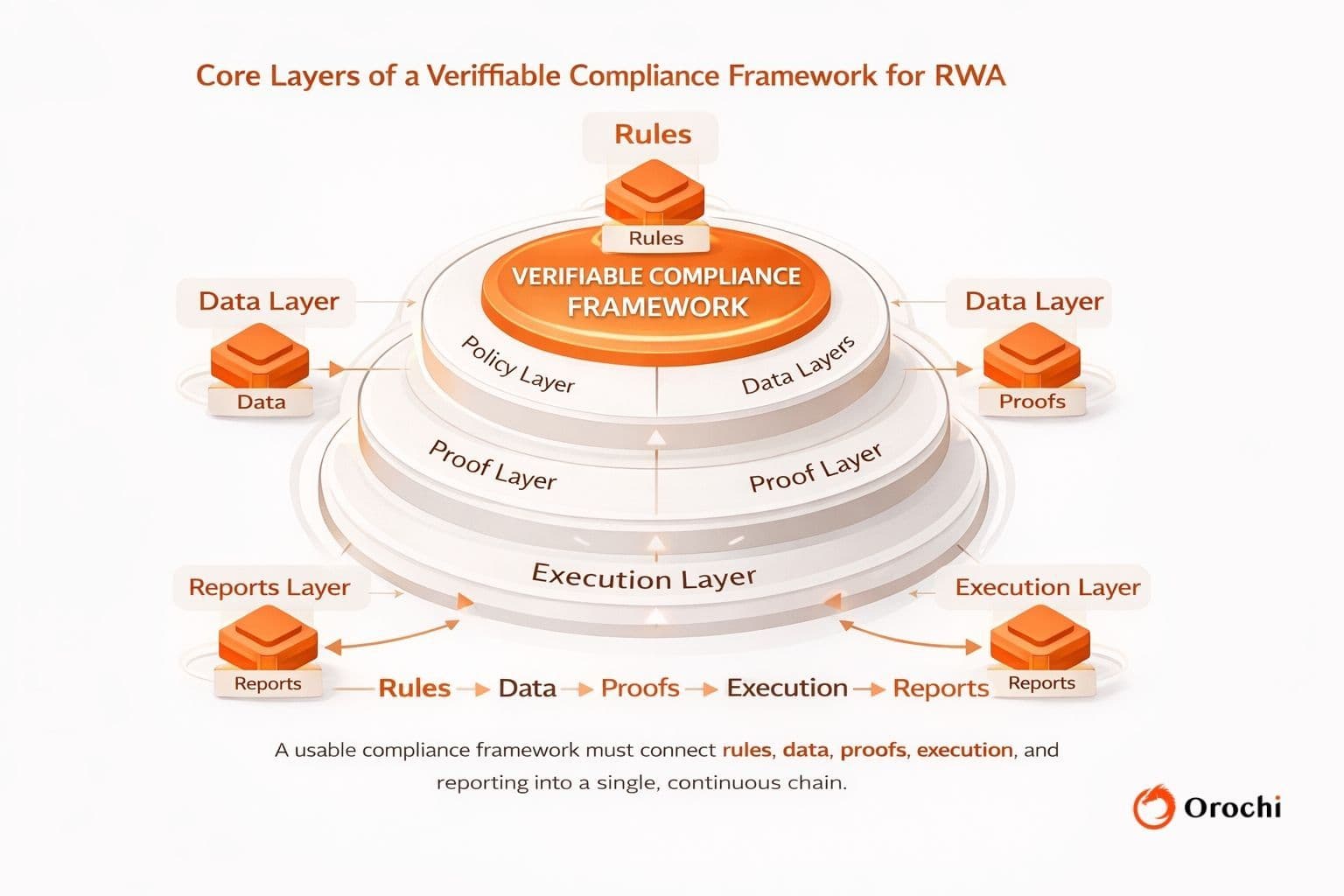
The Policy Layer in regulatory compliance for RWA
The Policy Layer defines compliance claims as testable assertions, similar to software test cases:
- Only allow-listed holders are permitted to receive tokens
- Reserves are reconciled on a defined cadence and proofs are generated as scheduled
- NAV calculations rely exclusively on approved inputs and methodologies
If a claim cannot be tested, it cannot be proven. This principle sits at the core of Compliance for RWA.
The Data Layer as the foundation of real compliance
The Data Layer serves as the evidence substrate for compliance: identity status, registry events, custodian balances, bank records, subscriptions, and redemptions.
Unversioned or mutable inputs produce results that cannot be verified. Versioned, lineage-aware data enables measurable and auditable Compliance for RWA.
The Proof Layer as the source of verifiable compliance
The Proof Layer generates independently verifiable evidence that data and computations followed defined policies, without requiring disclosure of raw information.
The BIS notes that standards such as ERC-3643 introduce integrated on-chain identity management, enabling permissioned transfers by linking token holders’ identities to compliance rules. The trajectory is clear: Compliance for RWA is moving toward machine-verifiable evidence, not document-based attestations.
The Execution Layer as enforceable on-chain compliance
The Execution Layer is where compliance rules become enforceable on-chain, including:
- Minting constraints
- Transfer restrictions
- Freezes or blocks when legally required
- Controlled redemption pathways
Deloitte highlights that tokenization frameworks can embed KYC and AML requirements directly into token behavior, including the ability to restrict or halt transfers to prohibited entities.
The Reporting Layer for audit-ready compliance
Reporting should be derived from the same evidence graph used in operations, not reconstructed after the fact. This includes replayable audit trails, proof artifacts tied to specific snapshots and events, and exception reports with documented remediation and approvals.
Proving Compliance for RWA without exposing sensitive data
Compliance for RWA often fails when transparency is mistaken for exposure. Regulators care about verifiable outcomes, not public disclosure of customers, bank identifiers, or private contractual terms.
- Sensitive RWA data must remain non-public by default PII, counterparty identifiers, bank details, and private contract terms should never be published, even when assets are on-chain. Access must be scoped internally, and breach blast radius reduced by design rather than after the fact.
- Privacy-preserving verification delivers verifiable compliance outcomes Compliance can be proven through statements such as eligibility validity, absence of sanctioned holders, reserves exceeding liabilities at a given time, and NAV computed from approved inputs within defined policy bounds. Orochi positions zkDatabase as a proof-agnostic platform that transforms raw data into verifiable, privacy-preserving evidence aligned directly with these compliance statements.
An auditor-ready audit trail defines whether RWA compliance is defensible
An auditor-ready audit trail is not a folder of documents. It is a replayable record of what happened, when it happened, who approved it, and which data and rules were used. For RWA compliance, the goal is to make every critical claim verifiable at a specific timestamp: eligibility checks at transfer time, reserve backing at reporting checkpoints, NAV methodology inputs at calculation time, and exception handling when controls fail. A strong audit trail also needs clear lineage, meaning you can trace each output back to its sources, transformations, and approvals without relying on memory or spreadsheets. This is why Compliance for RWA should be treated as systems design, not document assembly: the audit trail must be produced continuously by the workflow, not reconstructed after the fact.
Evidence auditors commonly request in RWA compliance reviews
- Eligibility state over time
- Holder status history (approved, suspended, revoked)
- Jurisdiction and investor-type flags at each state change
- Screening timestamps and the policy version applied
- Enforcement outcomes at execution time
- Transfer decisions (allowed, blocked, overridden) with reasons
- Rule triggers (sanctions hit, eligibility expired, limit breached)
- Override approvals with approver identity and rationale
- Backing and reconciliation evidence
- Reserve snapshots tied to custody and banking records
- Reconciliation deltas and exception resolutions
- Proof of reserves checkpoints, frequency, and methodology notes
- NAV and valuation inputs
- Pricing sources, timestamps, and approved data feeds
- Position and cashflow inputs used in each NAV run
- Reproducible calculation logs for audit replay
- Change-control and governance approvals
- Policy updates with version history (who changed what, when)
- Smart contract upgrades or parameter changes with approvals
- Vendor changes (custodian, KYC provider) and risk assessments
The minimum viable compliance dashboard for audit readiness
A minimum viable compliance dashboard should show state, not slogans. It should surface the live posture of Compliance for RWA by displaying the last proof timestamp and proof coverage by claim such as eligibility checks, Proof of Reserves, and NAV evidence. It also needs a clear operational risk view, including exception counts by type like screening failures, reconciliation breaks, and data gaps, plus a reconciliation delta trend and the aging of unresolved items so reviewers can see what is drifting and for how long.
On execution visibility, the dashboard should track allowed versus blocked transfers over time, highlight the most common rejection reasons, and log override activity with who approved the override and why. Finally, it must support fast audits through an audit export bundle that enables one-click audit replay for any selected time window, packaging the exact inputs, the applied rule version, event logs, exception handling history, and approvals so verification does not require manual reconstruction.
Why is zkDatabase a practical compliance layer for RWA builders who need verifiable evidence?
Compliance for RWA gets simpler when the data layer is built to produce proofs. Orochi Network’s Verifiable Data Infrastructure positions zkDatabase as a provable database that turns raw data into verifiable, privacy-preserving outputs for RWAs.
Traditional databases store truth but do not prove it. Oracle-only stacks can publish values but often stop short of proving end-to-end integrity across ingestion, transformation, and execution. A provable database approach targets the missing middle: verifiable data integrity from source to on-chain execution, which is exactly what Compliance for RWA needs to be audit-ready.
A practical starting point is two claims: proof of reserves for backing and eligibility enforcement for transfers. Ship them consistently, then expand into NAV inputs, cashflow reconciliation, and disclosure gating.
Conclusion
The RWA market is scaling fast. Tokenized treasuries are proving real distribution, while regulators across major jurisdictions are tightening expectations around custody, disclosures, and ongoing controls. The durable strategy is to engineer Compliance for RWA as a system: define the exact claims you stand behind, bind them to versioned data, generate proof-grade evidence on cadence and at key events, enforce rules at execution time, and make audits replayable instead of reconstructive.
This is exactly where Orochi Network fits. Orochi’s Verifiable Data Infrastructure is built around provable pipelines that move from verifiable data integrity for RWA at the data source to on-chain execution, turning what is still largely off-chain and unverifiable data into audit-ready, privacy-preserving outputs. With zkDatabase, issuers can produce proof-carrying data for PoR, NAV, eligibility, and audit trails, while maintaining practical data privacy in reporting.
FAQs
Question 1: What makes a compliance framework for Real-World Assets (RWA) verifiable and credible?
A verifiable RWA compliance framework links regulatory policies directly to versioned data. It ensures credibility by producing cryptographic proofs and preserving an immutable audit trail, allowing auditors to independently replay and verify adherence without relying on centralized trust.
Question 2: How can protocols prove RWA compliance without exposing sensitive user data?
Protocols achieve private compliance using zero-knowledge verification. This technology generates validity proofs for KYC/AML status, transfer restrictions, and Proof of Reserves (PoR), ensuring regulatory adherence while keeping raw records and personal identities completely confidential.
Question 3: How does zkDatabase support RWA compliance in production workflows?
zkDatabase functions as a verifiable data layer that transforms off-chain evidence into on-chain proof artifacts. It supports audit replays and feeds compliance checks directly to smart contracts, preventing data leaks while maintaining full integrity of the compliance process.


Experience verifiable data in action - Join the zkDatabase live demo!
Book a Demo