zkPass and Orochi Network are redefining decentralized identity by merging private, browser-based ZKP with a verifiable backend. zkPass lets users prove sensitive attributes, like KYC, credit scores, or academic credentials, without revealing the underlying data. Orochi’s zkDatabase strengthens this by anchoring those proofs in a tamper-proof, audit-ready state. Together, they create a scalable, privacy-preserving DID framework for Web3, RWA, and compliance-focused applications.
Who is zkPass ?
zkPass is a decentralized oracle protocol that converts private internet data (e.g., from HTTPS sites) into verifiable Zero-Knowledge Proofs on-chain, without exposing the raw data. It uses zkTLS (combining 3-party TLS, MPC, and hybrid ZK tech) for secure, local proof generation, enabling privacy-preserving verification for DeFi, identity, compliance, and more.
Founded in 2022 and backed by major investors (Binance Labs, Sequoia China, etc.), zkPass aims to become an “Oracle of the Verifiable Internet,” powering under-collateralized loans, decentralized identity (DID) passes, private AI data markets, and more.
How zkPass Works ?
In practice, zkPass works much like a private data oracle. A user first logs into any Web2 service (e.g. a bank or government portal) through zkPass’s modified TLS handshake.
The system then “scrapes” the encrypted attributes (such as age, account balance, or KYC status) and feeds them into a zero-knowledge circuit running locally in the browser. The circuit checks the desired claim (for example, “balance > $X” or “age ≥ 18”) and produces a succinct ZKP without ever revealing the underlying data.
The zkPass service then seals this proof, “like putting it in a tamper-proof envelope” – ensuring it hasn’t been altered. Finally, the proof can be submitted to a smart contract or dApp, which verifies it on-chain. This lets any application trust that the claim is true, without seeing the raw credentials. Key advantages include selective disclosure (only the proven statement is revealed) and local proof generation (the user’s device does all computation).
Despite its power, zkPass alone has some limitations.
Each proof attests to a single query at one point in time, but zkPass does not natively track a user’s DID state over time. In other words, there is currently no on-chain anchor or history for each proof (no tamper-proof DID state). Users also must log in and generate a new proof for each app (repeated verification), and the proofs themselves are not stored in a unified, queryable backend.

How zkDatabase can support for zkPass
zkDatabase significantly enhances the Decentralized Identity (DID) ecosystem by making identity data both verifiable and privacy-preserving. It uses ZK-data-Rollups to validate the entire database state with a single succinct proof.
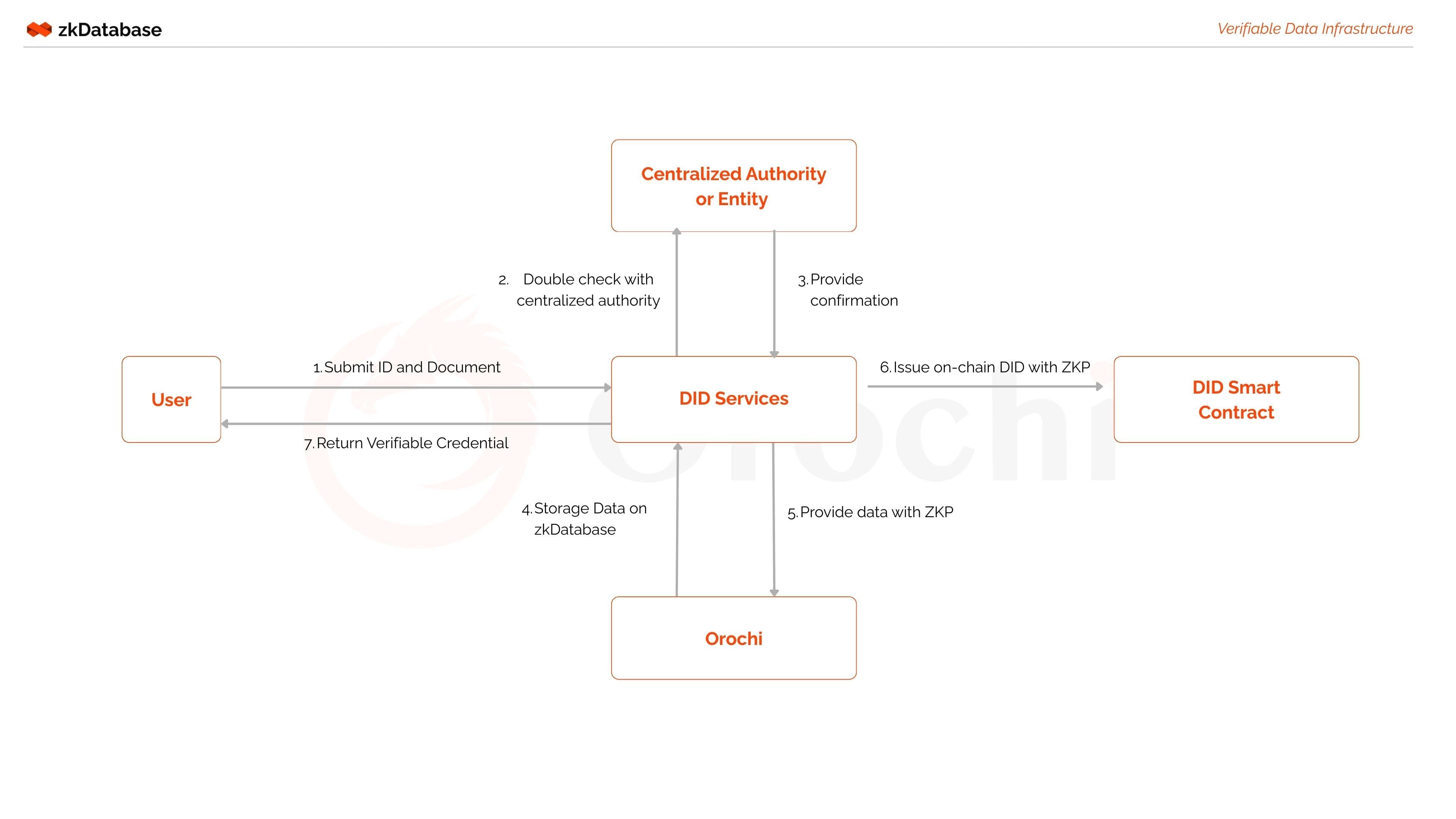
- ZK-data-Rollups: Compresses the full database state into a single zero-knowledge proof, enabling efficient verification.
- Claim-Level ZKPs : Generates proofs for individual identity attributes like age, residency, or accreditation.
- State Integrity Proofs: Embeds cryptographic attestations that each claim originates from a tamper-proof data state.
- Off-Chain Privacy: Keeps raw identity data private while allowing on-chain applications to verify claims.
- Cross-Chain Verifiability: Allows proofs to be validated across multiple chains or ecosystems.
- Audit-Grade Trust: Offers both granular (claim-level) and holistic (state-level) assurance, ideal for regulatory and enterprise adoption.
Conclusion
By integrating Orochi’s zkDatabase, zkPass gains a provable backend for its privacy-preserving proofs. zkPass continues to let users prove attributes without revealing data, while a ensures those attributes are anchored in an immutable, auditable ledger.
The result is a DID ecosystem where trust comes from math rather than blind faith: users enjoy decentralized identity with full privacy, and enterprises gain cryptographic guarantees of integrity. In short, zkPass provides the user-centric proofs and Orochi’s zkDatabase provides the provable data infrastructure, together enabling a next-generation DID system that is both private and compliance-ready.
FAQs
1. What is zkPass and how does it support decentralized identity (DID)?
zkPass is a privacy-preserving protocol that converts user data from secure Web2 sources into Zero-Knowledge Proofs
(ZKPs) without revealing the raw data. It allows users to verify attributes like KYC status, credit score, or age directly on-chain, forming the basis for decentralized identity (DID) without centralized authorities.
2. What challenges does zkPass face without a verifiable backend?
zkPass proofs are powerful but limited to point-in-time claims. Without a backend, it lacks:
- Tamper-proof DID history
- Reusability across apps
- Unified storage or audit trail
- Lifecycle compliance visibility
3. How does Orochi’s zkDatabase enhance zkPass capabilities?
- zkDatabase provides zkPass with a cryptographically secure backend. It:
- Anchors claims in tamper-proof state trees
- Generates ZKPs for every update/query
- Proves both the data and its origin
- Enables reuse of DID attributes across chains


Experience verifiable data in action - Join the zkDatabase live demo!
Book a Demo